In the Republic of Albania, Macedonian minorities live mainly in the district of Korça (Pustec Municipality), in the district of Devolli (Vrnik village), but also in the cities of Korça, Pogradec, Bilisht, Tirana, Durrës, Bilisht, Kukës, Librazhd, etc. Macedonian minorities live in the area of Golloborda (Peshkopi) and in the area of Gora (Kukes).
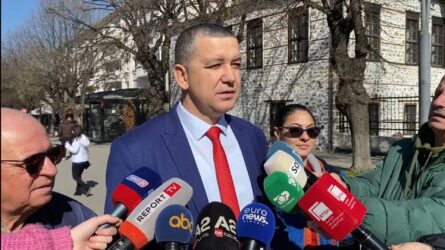
Vasil Sterjovski
The Macedonian minority residing in the municipality of Pustec and the village of Vrnik has been recognized by the Albanian state since the first years after liberation (1945) with the rights to the free use of the Macedonian mother tongue, the education of children up to the fourth grade of education primary, preservation and development of cultural traditions, customs, etc.
The position of the Macedonian minority in Albania has not been the same historically, since for the period from the creation of the Albanian state until the end of the Second World War, this minority was not recognized by the state. After the end of the Second World War, from 1945 to 1948, when Albania had good relations with the Federal People’s Republic of Yugoslavia, the Macedonian minority was officially recognized in the area of Prespa, the area of Golloborda and in the village of Vrnik, in the area of Devoll.
With the democratization of life in the country, the process of affirmation and integration of the Macedonian minority began. Appropriate conditions were created for the organization and action of Macedonians in Albania, especially in terms of the protection of national and ethnic identity, the cultivation of culture and national tradition.
The democratic state, after 1991, based on international conventions and the laws of the country, further enriched the rights mainly in the field of education, completing the curricula for the education of Macedonian minority children up to the eighth grade (with about 60% of the teaching subjects in the language native Macedonian) and in the first two years of general secondary school in the minority area, the subject of the mother tongue and literature is taught.
Several organizations and associations function for the protection of the rights of the Macedonian minority in our country. These associations in different ways try to preserve the most important features of their national origin, culture, tradition, customs, language, folklore, etc., and continuously increase the awareness of the special Macedonian identity and have significant achievements in that.
1.Guaranteed seats in parliament for minorities
The current electoral system does not guarantee the possibility of minority representation in Parliament, it is necessary to make appropriate interventions in the Electoral Code and regulate the participation of minorities with guaranteed seats in Parliament, where minorities have their voice, since no one better than their own representatives, they cannot protect and address the problems of minorities.
There is a lack of real political will and sufficient support from society to support the demands for changing the provisions of the electoral legislation to guarantee the representation of minorities in Parliament with guaranteed seats, as in many European countries, which have different forms for the representation of minorities in Parliament and participation in public life.
Speech of MP Vasil Sterjovski in the Parliament of Albania on guaranteed seats in the Parliament for minorities.
2.Education in the Macedonian language
The Macedonian minority in Albania, based on the legal framework, enjoys the right to education in the mother tongue, the preservation of traditions and the development of culture as a factor of identity and coexistence in a pluralistic society.
Currently, he is facing a series of problems that make it difficult to implement in practice these rights guaranteed by laws.
Presently education in the Macedonian language is permitted in the region of Prespa. No education is permitted outside this region. It is not allowed to teach the Macedonian language for the Macedonian minority in the areas of Gora and Golloborda, as well as in various cities in Albania where there is a significant part of the Macedonian minority.
Not all textbooks in the Macedonian language for schools in the area of Prespa in the municipality of Pustec are published by the Ministry of Education of Albania, but even those textbooks that are published in the Macedonian language are of poor quality.
We ask the Government to establish a separate educational office in the Pustec Municipality or at the district level, which will deal with the management of all the problems of the educational process in the ethnic Macedonian minority schools in the Pustec Municipality, in the coordination of the management links to overcome the obstacles bureaucratic for the provision of textbooks in the Macedonian language, for the quality of the texts, for the level of educational personnel, as well as for the teaching of the Macedonian language in other areas where there are minority members. This office, having a direct relationship with the Minister of Education, will be a promoter of quality improvement in all aspects of the learning process in the Macedonian language.
Speech of MP Vasil Sterjovski in the Parliament of Albania on the establishment of a special educational office in the municipality of Pustec.
3.Albanian Radio Television and information in the language of minorities
According to the law “On the protection of national minorities in the Republic of Albania”, a Albanian Radio Television through the RTSH2 channel started broadcasting news and programs in several minority languages.
Due to the lack of funds, there are still deficiencies in the duration and content of broadcast programs which do not respond to the real needs and problems of minorities.
We ask the Government to support Albanian Radio Television with funds to create a newsroom that will belong only to minority journalists in RTSH2 where they will have the opportunity to be the creators of shows, chronicles, reports and informative editions for the minority they represent as well as to engage correspondents from the minorities, who will be on the ground near the areas where the minorities mainly live and deal with different topics.
Speech of MP Vasil Sterjovski in the Parliament of Albania on the establishment of a minority newsroom at the Albanian Radio Television.
4.Proclamation of Christmas according to the Julian calendar as a public holiday for Macedonians, Serbs and Montenegrins of the Orthodox faith
The Macedonian, Serbian and Montenegrin minority of the Orthodox faith in the Republic of Albania celebrate Christmas with the Julian calendar on January 7. Christmas is one of the most important holidays for Orthodox Christians, and for this purpose, celebrating them in a dignified manner is a must for all Macedonian, Serbian and Montenegrin national minorities.
Currently law no. 96/2017 “For the protection of national interests in the Republic of Albani”, in article 12, paragraph 2, it is defined: “Persons who belong to national interests enjoy, in accordance with Article 2 of this law, the right and celebrate the events related to the promotion and identity of their distinctive culture.”
From the analysis of the provisions of law no. 7651. dated 21.12.1992. “On official holidays and commemorative days”, amended”, this specific right of these minorities cannot be implemented and has not been reflected.
On December 16, 2019, MP Vasil Sterjovski filed a draft law in the Parliament of Albania requesting the addition of January 7 as Christmas Day for the Macedonian, Serbian and Montenegrin national minorities.
The Pustec Municipality Council, the State Committee of Minorities as well as the associations representing the Macedonian, Serbian and Montenegrin minorities expressed their support for this draft law.
The Parliament of the Republic of Albania did not take into account this draft law.
http://www.parlament.al:5000/Files/20191217125940NDRYSHIM%20NE%207651%20(DEPUTET).pdf
5.Territorial reform and establishment of separate municipalities Gora and Golloborda
In 2014, the Assembly did not take into account the criteria set by the government regarding minorities, and with the approved version of the Administrative-Territorial Reform, the requests of the Macedonian community were not taken into account, where in addition to the Pusteci Municipality in the Prespa area, the Municipalities of Gora were also created. in the District of Kukës and Golloborda in the District of Dibra.
Residents of the Macedonian community in the areas of Gora and Golloborda are today more underrepresented. There are no councilors from the area of Gora and Golloborda in the municipal councils of Kukes and Bulqiza, and the residents of these areas who are employed in the administration of the respective municipalities are counted on the fingers.
Funds are allocated towards urban centers and we have no serious investment from the municipalities of Bulqiza and Kukes or the central government in the areas of Golloborda and Gora, even though there is a lack of drinking water, sewage, rural roads, electricity, etc.
Today, the residents of the Golloborda and Gora areas travel by special vehicles for more than two to three hours on unpaved and unpaved roads to get a service in the Municipality of Bulqiza or Kukes.
In winter, it happens that the Golloborda and Gora areas are blocked for months due to snow and the residents are forced to clean the roads themselves, while the villages remain without electricity for weeks. The road infrastructure in these areas is in a very bad condition, there are still no paved roads.
It is perhaps the unique case in the world where residents of the administrative unit Trebisht, in the area of Golloborda cross two border points in Macedonia to go to the municipality center in the city of Bulqiza to receive a service, because the road that connects the area of Golloborda with Bulqizë is amortized and unpaved.
The same situation is in the area of Gora in Kukës Municipality. Even here, the residents of the village of Borje, due to the amortized and unpaved road that connects this village with Shishtavec and Kukës, cross two border points in Kosovo to get a service in the city of Kukës.
Due to bad living conditions and extreme poverty, a large number of residents have left the areas of Golloborda and Gora in the direction of Elbasan, Durrës, Kukes, Tirana, and abroad. This trend of population migration continues today.
In 2017, the Assembly approved Law No. 96/2017 “On the protection of national minorities in the Republic of Albania”. A good part of minority rights is related to the percentage they occupy in the municipalities. This law regarding the Macedonian community is almost only applicable in the area of Prespa in Pustec Municipality where 100% Macedonian population lives.
We request that the Golloborda area, with its three administrative units, the Ostreni, Stebleva, Trebisht Units, be created a separate municipality with the name Municipality of Golloborda, as well as the Gora area with the Shishtavec and Zapot administrative units, create a separate municipality with the name Municipality of Gora.
The Macedonian representatives in the Parliament of Albania regarding the establishment of individual municipalities of Gora and Golo Brdo.
https://dosja.al/politike/reforma-territoriale-minoriteti-maqedonas-pusteci-te-emertohet-bashkia–i229751
Reforma territoriale, cilat janë dy bashkitë e reja që kërkon komuniteti maqedonas
6.Representation of Macedonians in state bodies and other public institutions and in local self-government at all levels
We demand fair and adequate representation of Macedonians in state bodies and other public institutions and in local self-government at all levels.
Speech of MP Vasil Sterjovski in the Parliament of Albania on representation of Macedonians in state bodies and other public institutions and in local self-government at all levels.
7.Adequate budget for local government units, where there are minority communities
In 2014, the Institution of the People’s Advocate drafted a special report on the situation of minorities in the Republic of Albania, where one of the main recommendations was the creation of conditions for increasing well-being in areas where minorities and other communities live, including financing with a more adequate budget for local government units, where there are minority communities and other communities to a different extent from the rest of the majority population, this recommendation is still not being implemented.
The areas where the Macedonian minority lives in Pusteci Municipality in Prespa Area, Golloborda Area in Bulqiza and Librazhd Municipalities, Gora Area in Kukës Municipality as well as Vrnik village in Devoll Municipality are the poorest areas in our country left behind hand by all governments in the last 30 years without the necessary road infrastructure, water supply, sewerage, health service, electricity, etc. These areas urgently need support and investment from the government to improve the socio-economic living conditions.
Speech of MP Vasil Sterjovski in the parliament about the economic situation of the areas inhabited by Macedonians.
8.State Committee of Minorities
In 2004, the government created the State Committee of Minorities as a central institution under the Prime Minister, tasked with improving the protection of the country’s minorities. As it has been established in many reports of international institutions that deal with the rights of minorities, this institution has been vulnerable to political interference, resulting in its full control by the executive and its transformation from a protection body of minorities, in a body harmful to the dialogue between the government and minorities.
9.Bulgaria’s attempts to assimilate the Macedonian minority in Albania
In 2017, the Parliament adopted the Law on the Protection of the Rights of Minorities in the Republic of Albania. Although the draft law of the Ministry of Europe and Foreign Affairs to the Parliament notes the existence of the eight national minorities (Greeks, Macedonians, Vlachs, Serbs, Montenegrins, Bosniaks, Roma and Egyptians), at the last moment, Albania succumbed to pressure from Bulgaria with blackmail for a veto for entry into the European Union and recognition of the non-existent Bulgarian minority in Albania was inserted into the law.
And then, we, as the Macedonian community in Albania, strongly protested, reacting that we are against denying the rights and freedoms of any person, group of citizens or community, but in this case it is not about the Bulgarian minority!
We pointed out and confirmed that it is about the existence of the Macedonian minority and that the recognition of the Bulgarian minority means genocide for the Macedonians in Albania. At the same time, we pointed out that Bulgaria will abuse its membership in the European Union in order to deepen the above-mentioned goal: Assimilation of the Macedonian community in Albania and the creation of a non-existent Bulgarian community.
The law does not say where this minority lives in Albania, but Bulgaria, referring to this law, directed its propaganda in the regions where the indigenous Macedonian minority in Albania traditionally lives: in the Prespa, Golloborda and Gora areas, as well as in the village of Vrbnik in Devoll area.
In Albania, according to all historical facts and censuses carried out over the years, including the last census of 2011, in the districts of Prespa, Golloborda, Gora and Vrbnik, where Bulgaria “requires” a Bulgarian minority, there is a self-proclaimed Macedonian minority that has the same folklore, tradition and language like the Macedonian people as a whole in all the countries of the Balkans, lives in compact areas on the border with Macedonia and has territorial continuity with the state of Macedonia, has nothing to do with Bulgaria!
One of the measures to create an artificial Bulgarian minority in Albania, which Bulgaria applies, using the poor economic situation of the Macedonian minority in Albania but also of the Albanian citizens together, is by giving Bulgarian passports to all Albanian citizens.
Macedonians and Albanians pay thousands of euros to be able to take a Bulgarian passport and go to work in the West, using the privileges of EU member states. This is a business worth millions of euros, which operates not only in Albania, but also in several countries that are not members of the European Union, such as Macedonia, Kosovo, Serbia, Ukraine, Moldova and others. Several times in Bulgaria itself, proceedings have been initiated by the Bulgarian prosecutor’s office against Bulgarian officials involved in the business with Bulgarian passports. Of course, this business with Bulgarian passports is a problem for Bulgaria and the European Union. When Albania becomes a member of the European Union, all these attempts of Bulgarian propaganda will fall into the water, they will burst like a soap bubble! Then no Albanian citizen will pay Sofia by fictitiously declaring himself Bulgarian as a condition for a Bulgarian passport, to reach the markets and privileges of the European Union.
This Bulgarian propaganda is especially intensified in anticipation of the upcoming population census, so that Bulgaria can justify its aggressive policy, but also the money it spends to show a Bulgarian minority in Albania at all costs.
We appeal to the Albanian institutions not to succumb to pressure from Bulgaria, which as a member state of the European Union exerts pressure, blackmail and threats with the Bulgarian veto. We appeal to the Albanian institutions to monitor the Bulgarian attempts to artificially create a non-existent Bulgarian minority in Albania and pay Albanian officials to extract a percentage of Bulgarians in Albania.
Speech of MP Vasil Sterjovski in the parliament regarding Bulgaria’s attempts to assimilate Macedonians in Albania.
10.The Minorities Fund
Although this fund was not satisfactory, we waited for the announcement of the competition by the Committee for National Minorities to compete with projects that aimed to protect the rights and freedoms and improve the position of national minorities and preserve and promote their ethnic identity , linguistic, cultural and religious.
The Chairperson of the Committee for National Minorities Mrs. Konstatina Beziani, without consulting the associations of national minorities, allocated the entire fund to the Greek cultural association “Saint Kozmai”, which on November 5-6, 2022 organized the festival for national minorities in Livadhja, Finic municipality.
We asked the Chairperson of the Committee for National Minorities to finance as many projects as possible from this fund aimed at protecting the data of national minorities, preserving and promoting their cultural, ethnic, linguistic, traditional and religious identity, but Ms. Konstatina Beziani did not consider our requests.
The request of all minorities is that the minority fund be distributed to all minorities to support their initiatives.
11.The law 96/2017 “On the protection of national minorities in the Republic of Albania”
On 13.10.2017, the Assembly of Albania approved the law 96/2017 “On the protection of national minorities in the Republic of Albania”, a law which was supposed to fulfill a legal gap for the treatment of minorities in Albania and the fulfillment of the criteria for membership in the European Union. In the last provisions of the law (Article 23), the Council of Ministers was tasked “within 6 months from the entry into force of this law, to approve by-laws in implementation of this law. The law was published in the Official Gazette on 9.11.2017 and entered into entered into force on 24.11.2017. So, the law obliged the government to approve all by-laws 6 months after coming into force, specifically before May 24, 2018.
Although almost six years have passed since the adoption of this law, all by-laws have not yet been approved and this law is not being implemented.
Request of MP Vasil Sterjovski in the Committee for Foreign Affairs of the Albanian Parliament to the Minister of Foreign Affairs why the sub-legal acts for the implementation of the law for the protection of national minorities are not adopted.
MP Vasil Sterjovski’s request to the Speaker of the Albanian Parliament why the interpellation with Prime Minister Edi Rama is not held regarding the observance of the law on the protection of national minorities.
12.Census Law
As in the Census Law in 2011, and in the new law, Article 22 provides for administrative offenses with fines from 50,000 to 100,000 lek (410 to 820 euros) for providing data on the question of ethnic origin, if it is in contradiction with the data registered in the civil registry. We believe that the registry itself represents an unreliable source of information. Article 22 is in conflict with international instruments that guarantee freedom of expression or not with an ethnicity different from that of the majority of the population.
The Government and the Parliament should take into account the recommendations of international institutions and in the census law they should abolish the provisions that apply penalties for incorrect answers about ethnicity, avoiding at the same time any action that could put pressure on the free choice of expression of any person
13.The use of Macedonian toponyms
In the 70s of the last century, the People’s Assembly changed the names of the villages in the area of Prespa.
After the fall of Communism, the residents of the Macedonian community in the Prespa area have continuously made efforts to return the Macedonian toponyms of the villages.
Thanks to the negotiations of the Alliance of Macedonians for European Integration party with the parliamentary parties, in 2013 the Assembly voted to change the name of Liqenas municipality to the old name Pustec Municipality.
In 2013, with the decision of the Pustec Municipality Council and the approval of the Korça Prefecture, the names of the villages in the Prespa area were also changed, restoring the traditional Macedonian names.
Residents react that even though 10 years have passed since the village names were changed in the Pustec Municipality, the old names have not been changed on the information boards, road signs, institution boards, etc. and many institutions use the old names in official documents.
We call on the institutions that are related to Pustec Municipality to respect the law and use the changed names of the villages.
Speech of MP Vasil Sterjovski in the parliament regarding the use of Macedonian toponyms in the region of Prespa.
14.Ratification of the European Charter for Regional or Minority Languages
Albania is the only country in the region, a member of the Council of Europe, that has not signed the European Charter for Regional or Minority Languages.
All the opinions of the Advisory Committee of the Framework Convention for the Protection of National Minorities but also the progress reports of the European Council identify a number of shortcomings regarding the right of minorities in Albania to communicate with governmental and local authorities in their own languages, as well as regarding the display of names of places, streets and other topographical indicators in minority languages.
In the National Plan for the Stabilization and Association Agreement 2012-2015, the proposal of the Minorities Committee for the signing by the Government of the European Charter for Regional or Minority Languages was included.
Vasil Sterjovski


